
When you hire a new cleaner for a shopping mall, they start on Monday. Someone walks them around, shows them the service corridors, points out which lift goes to the basement, and by Wednesday they're productive.
When you deploy a cleaning robot in the same mall, something stranger happens. The robot arrives knowing nothing. Before it can do a single useful thing, it has to survey the building — driving every corridor, mapping every wall, building its own private model of a space that thousands of people already understand perfectly well.
That survey takes hours, sometimes days. And here is the part that should bother every property owner: when the security robot from a different vendor arrives next month, it does the whole thing again. Its own survey. Its own private map. Its own understanding of the same building. Then the delivery robot. Then the inspection robot.
Every robot re-scans every building. And when the mall changes a tenant layout, they all have to do it again.
We think this is backwards.
Autonomy is the driving skill. It is not the map.
There's a useful comparison sitting in a lot of driveways.
A Tesla with Autopilot engaged is a useful comparison. Its cameras and sensors read the lane, the car ahead, the pedestrian stepping off the kerb — that's autonomy, and it's genuinely impressive. But look at the screen: that blue path showing the route, the road boundaries, the junction ahead — that isn't coming from the cameras. It comes from map data the car was given before it ever started moving.
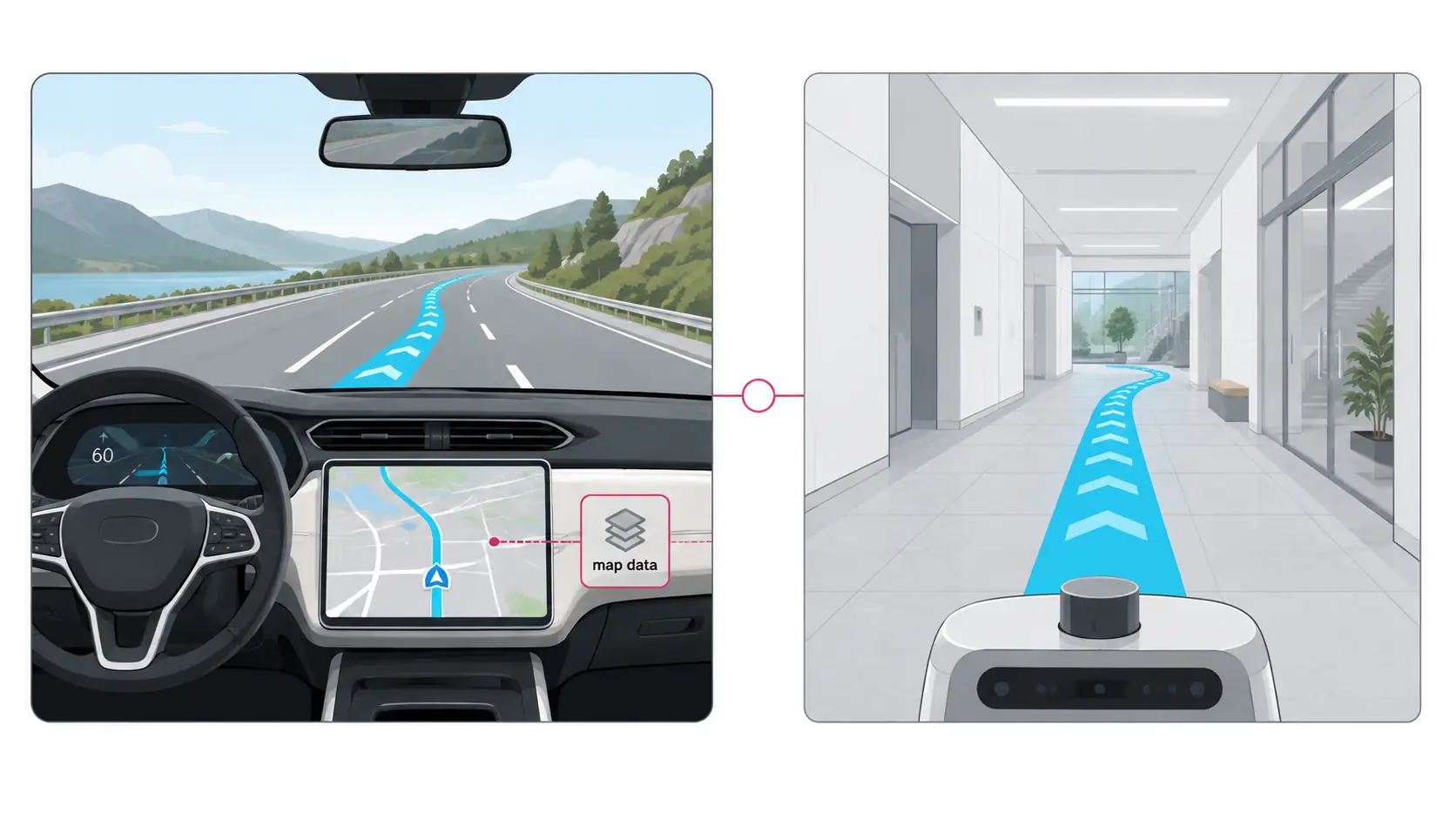
Autonomy is the driving skill. But to get from Chicago to New York, you still need a map.
Indoors, robots have the driving skill. What they don't have is the map. So each one improvises its own, privately, from scratch — the equivalent of every driver having to survey the interstate before their first trip.
Two layers, and only one of them should be the robot's job
Once you separate these, the whole problem looks different.
Local reaction belongs to the robot. A person steps into its path, a box is left in a corridor, a door is propped open — the robot's own lidar and cameras handle that, in real time, and they're good at it. This is where robot makers have invested a decade of engineering, and nothing should take it away from them.
Global understanding does not belong to the robot. Where the service corridor leads. Which lift reaches level B2. Which route is step-free. What that room is called, and what it's for. This is a property of the building, not of any particular machine — and it should be created once, maintained by the people who manage the building, and read by every robot that arrives.
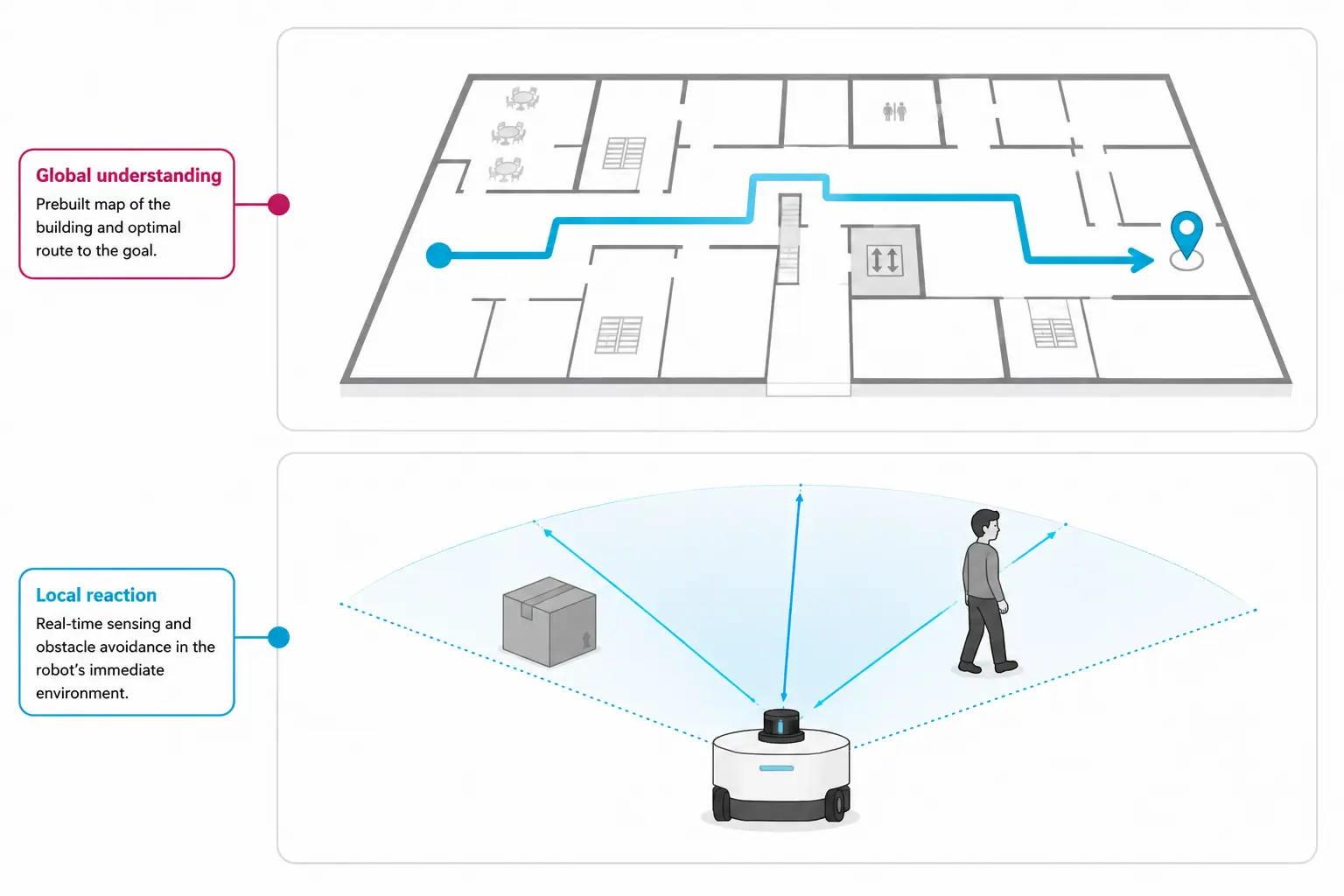
Today the industry makes each robot solve both. That's why deployment is slow, why every vendor is a separate project, and why a layout change breaks everything at once.
What we did
Mapxus has spent a decade building indoor maps of real buildings — over 7,500 of them across Asia Pacific, most from nothing more than an outdated floor plan and an on-site survey. Those maps already serve people through their phones and AI agents through our APIs.
So we asked a simple question: could the same map serve a robot, with no survey at all?
We built Map2USD — a pipeline that converts a Mapxus indoor map into an OpenUSD scene, the scene format the robotics world is standardizing on. Then we tested it in NVIDIA Isaac Sim.
We converted a fifteen-floor venue, at roughly one minute per floor: geometry, physics collision layers, and a localization map. We translated our 3D address — latitude, longitude, floor — into the robot's own coordinates, and handed it a wayfinding route. The robot then completed a seventy-meter route with twelve-centimeter endpoint accuracy and zero collisions.
In a building it had never scanned.
To be precise about what that is and isn't: the route-following is our own motion controller working with standard ROS 2 localization, and the obstacle avoidance still belongs to the robot's own sensors, exactly as it should. What changed is that the robot never had to build its own map. We handed it one.
This work was recognized in the NVIDIA Inception Grand Challenge 2026, where Mapxus was selected in the Top 40 for Physical AI. And it isn't only simulation: through our partnership with Kawasaki Heavy Industries, robots are already operating on Mapxus maps in a live hospital environment.
From HRM to RRM
Here's why this matters beyond robotics.
Property teams have spent years building what is essentially human resource management for buildings — rosters, work orders, SOPs, inspection routes, training. And increasingly, AI assistants that help staff do that work.
But there's a quiet crisis underneath it. In the United States, 39% of facilities managers are over 55, against 28% across all occupations. The people who know where the water valve is, which lift is unreliable, and what went wrong on level 3 last winter are retiring — and that knowledge lives in their heads, not in any system.
The fix for that problem and the fix for the robot problem turn out to be the same thing: put the building's knowledge on the building's map. Pin every event, inspection, near-miss and procedure to a 3D address. Then a new joiner with a phone can find what a twenty-year veteran knows, standing in the same spot — and so can an AI agent, and so can a robot.
That's what we mean by Robot Resource Management. Today's mobile workforce is human, supported by AI that finally understands where things are. Tomorrow's includes robots. Same map. Same knowledge base. One onboarding process for a workforce that happens to include machines.
Map once. Reused by any robot.
The buildings being digitized today for wayfinding, safety and operations are the same buildings that will host robot fleets in five years. The work doesn't need to be done twice.
That's the whole idea: map once, and let every consumer read it — people, AI agents, and machines.
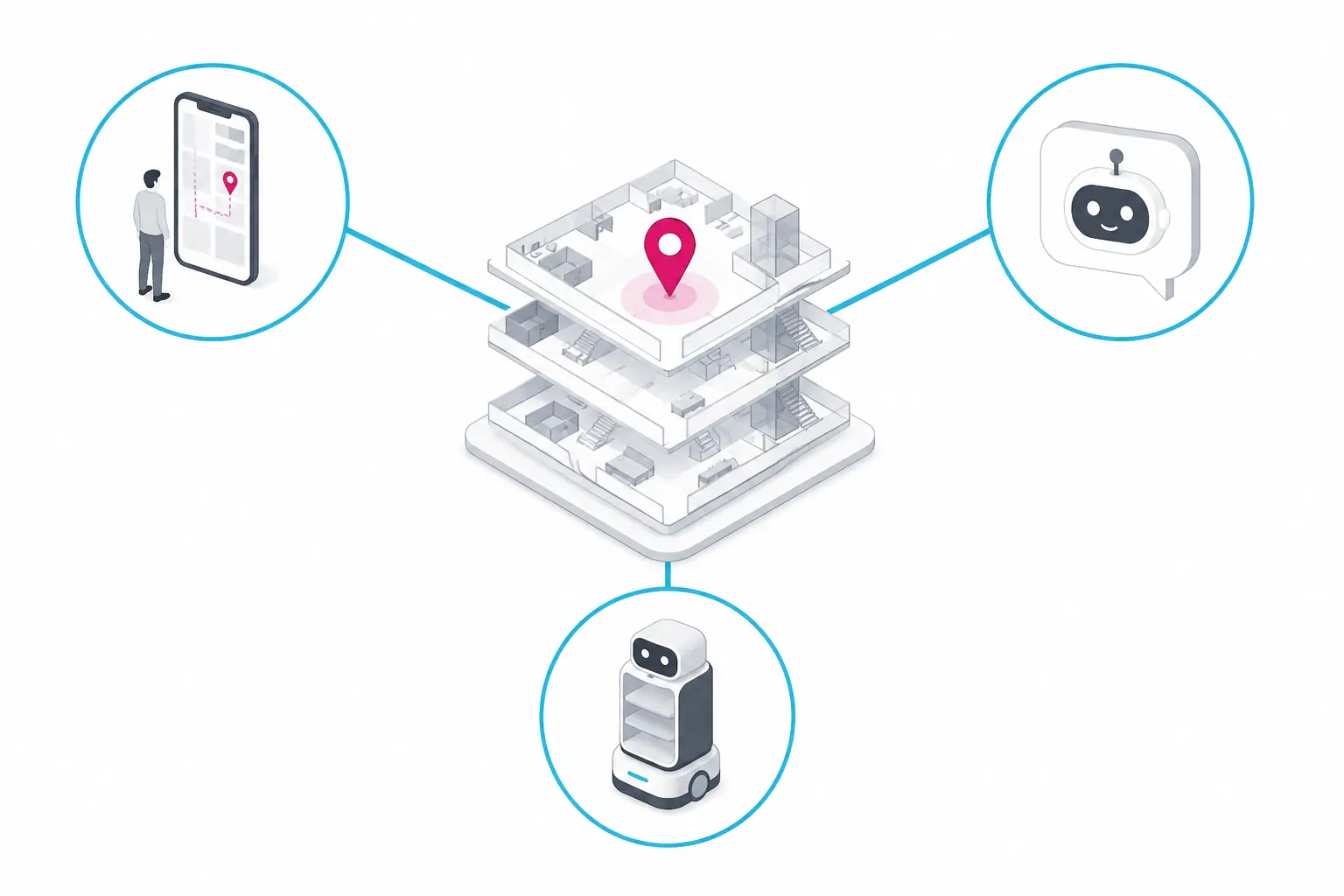
If you manage a portfolio and you're starting to think about robots, the most useful thing you can do isn't to evaluate robots. It's to make sure your buildings are readable before they arrive.
Want to talk about robot-ready buildings? Get in touch.